Wasted large language models
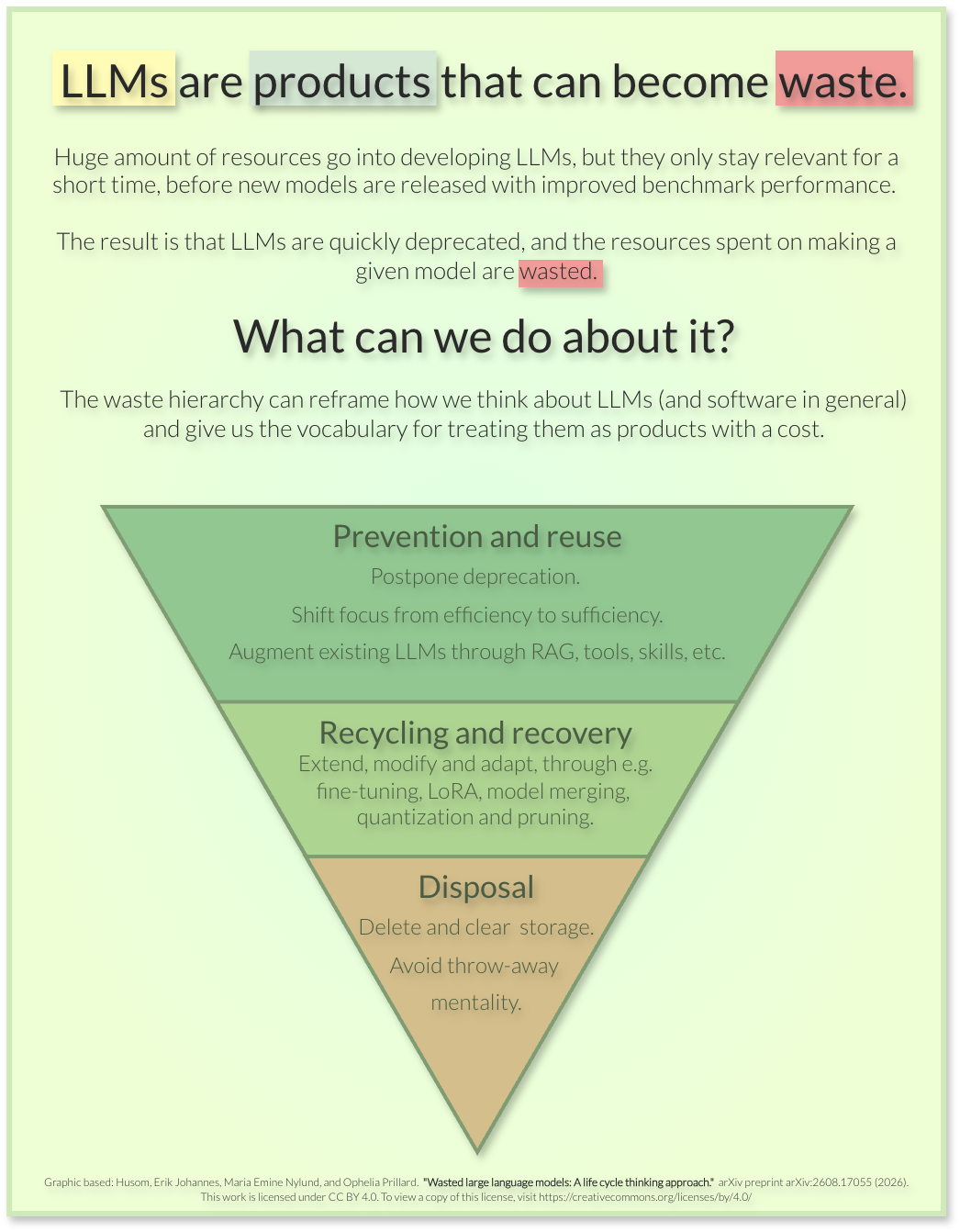
Earlier this year I was developing some guidelines for more environmentally-friendly use of generative AI for the Norwegian certification foundation Eco-Lighthouse. In this process I collaborated with Stine Vintervoll, senior advisor from Eco-Lighthouse, who one day asked me: "Could we somehow connect AI's climate footprint with the waste hierarchy?"
The waste hierarchy is a framework for managing waste to reduce environmental imapct. In its most basic form, it consists of 1) prevention, 2) reuse, 3) recycling, 4) recovery, and 5) disposal. I instinctively thought that this was a very interesting idea, but we struggled with concretizing how it would look like in practice, and in what sense it would make sense to talk about "waste management" in the context of AI.
After pondering this idea for a few weeks, I realized that we think about AI models in a very different way than we think about physical products. The latter end up as physical waste that we're forced to handle, one way or the other. With AI models, and especially large language models, the situation is different: We use enormous resources to develop them, but it doesn't take many months (or weeks, or days) before another model is made that makes existing models deprected—and thereby they're no longer used. Since it doesn't cost anything to stop using an AI model, and it doesn't leave any physical waste or residue, the waste of deprecation is hidden.
I looked into EU's Waste Framework Directive, and decided to write a short research paper together with my colleauges Maria Emine Nylund and Ophelia Prillard from SINTEF for the 2nd International Workshop on Low Carbon Computing 2026. The paper is called "Wasted large language models: A life cycle thinking approach" (and yes, the title was chosen because of the double meaning of "wasted LLMs").
The idea is that the waste hierachy can inspire and guide us to better use of the resources that have gone into training large-scale AI models, and to avoid wasting what we have already spent. We don't introduce any new techniques or methods—the paper is mainly about how we as individuals and society think about immaterial products like AI models. Waste management principles can reframe the issue of AI's climate footprint, and also give us the vocabulary we need to talk about better use of resources in this context.
What is unique about our paper is that we look specifically at LLMs as a product that can become waste (or more accurately, that the resources that went into making the product can become wasted)—and not the fact that LLMs can waste resources by being used. Preventing unnecessary use of LLMs is outside the scope of our paper, but since it's such an obvious way of reducing the climate impact, we address this topic briefly in Section 3.4 of our paper.
I'm skeptical and worried about widespread use of LLMs, especially given various forms of inflation and rebound effects, so I'm not arguing that we should use LLMs more. I simply wanted to point out that we typically ignore that LLMs have very short lifespans (even shrinking lifespans), and that we could save a lot by slowing down the deprecation rate. So, if we are determined to use LLMs no matter what, we should at least try to not waste so much.
Of course, it is not very realistic that AI labs will be inspired by this way of thinking. Most (all?) frontier labs are locked in a race, and having the best model(s) on the market is crucial for their continued existence. I have no illusions regarding the feasibility of guiding development efforts through this kind of framework—it will only happen if it aligns with economic incentives.
Read the paper here, or check out the summary graphic I made of the paper at the beginning of this post.